2024 study · PLOS Computational Biology
following the crowd as a shortcut
participants with damage to brain regions that help weigh risk relied more on copying other people’s choices. many healthy adults used the same shortcut, especially those whose own choices were harder to explain from their risk preferences.
when you’re not sure how to judge a choice, other people’s choices can give you something to follow. we tested this in participants with damage to the insula or the dorsal anterior cingulate cortex (dACC), two regions that help weigh risk; the damage came from brain surgery they’d had before the study. they chose between gambles, sometimes after seeing what two other players picked. compared with 28 healthy adults, they relied more on simply copying the other players.
many healthy adults used the same shortcut. across all participants, the harder it was to explain someone’s solo choices from their own risk preferences, the more they copied others when they had the chance. we think this reflects a general strategy: when judging the options yourself is difficult, other people’s choices can fill the gap.
a game you can’t fully see
imagine you’re at a trailhead in another country. the signs list each trail’s distance and difficulty, but you can’t read them. the trails are color-coded, though, and you see two hikers ahead of you take the red one. which would you take?
the game on the right works the same way. you’ll choose between a red gamble and a blue one, and you’ll always see which color two other players picked. some gambles are clear, and some are fogged over.
a choice that’s hard to judge
the fog in the game is an analogy. the participants in our study could read the gambles just fine, but some of them had damage to brain areas that help weigh risk, which can make judging those gambles harder. we wanted to know whether they would rely more on other people’s choices.
we studied participants with damage to one of two regions that help weigh risk: the insula and the dorsal anterior cingulate cortex (dACC). the damage came from brain surgery they’d had before joining the study, and the maps on the right show where each group’s damage overlapped. like you, they chose between safer and riskier gambles, sometimes alone and sometimes after seeing two other players’ choices.
next: choices from 28 healthy adults, 10 people with insula damage, and 6 with dACC damage.
two ways another person’s choice can sway you
another person’s choice can sway you in two ways. it can make that option seem more valuable to you (what we called ‘other-conferred utility’ in our study of teens), or you can simply copy it without weighing the option yourself (‘following’).
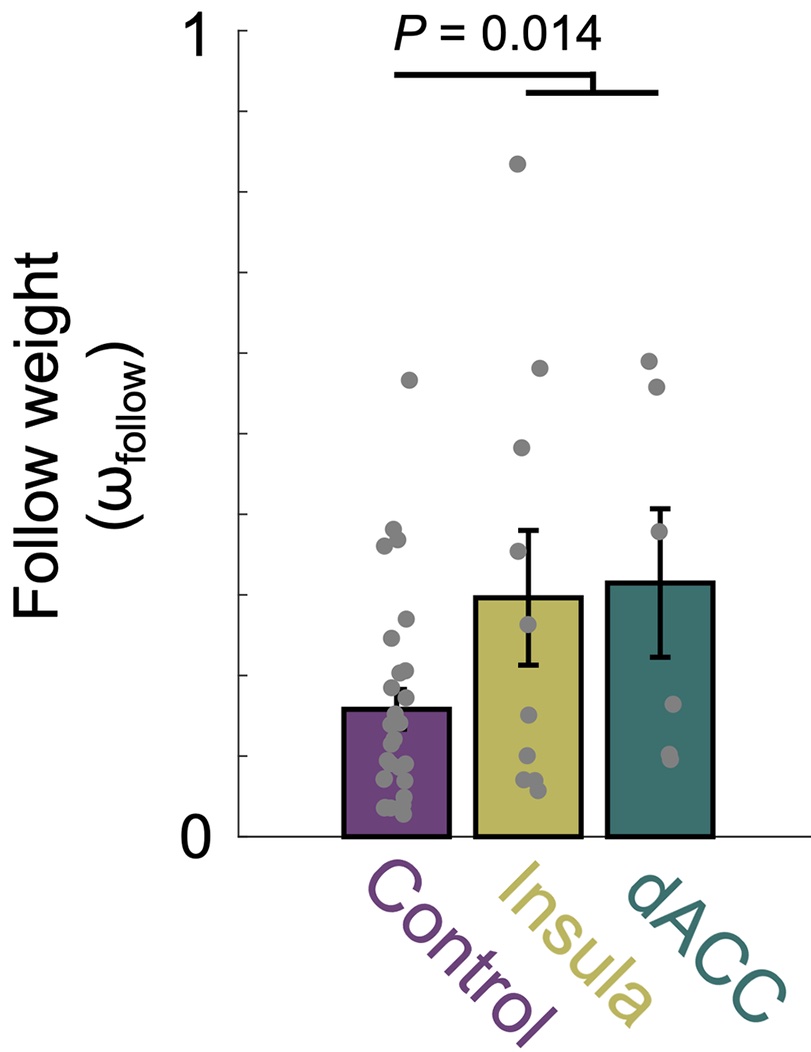
how did we tell these apart? we used a computational model, a series of equations with parameters that are fit to each participant’s choices, that estimates how much each strategy drove their decisions, alongside their own ‘risk preference’. in the plot on the right, each dot is one participant, and higher means they relied more on following.
the height is the model’s ‘following weight’, not the share of times someone copied.
the lesion groups copied more
both lesion groups relied on following more than the healthy adults did. the grey circles are the group averages.
now look at the individual dots. many healthy adults also relied on following, and every group varies a lot. studying the lesion groups helped us identify a strategy that shows up, to some degree, in everyone’s choices.
harder solo choices, more copying
now the dots move sideways. left to right shows how well each participant’s solo choices, made without seeing anyone else, were explained by their own risk preferences (we call this ‘solo mismatch’). farther right means a worse fit: their own risk preferences explained their choices less well.
the line slopes up: participants whose solo choices were harder to explain from their own risk preferences relied more on following when they had the chance. in other words, following others may fill the gap when your own evaluation of the options isn’t giving you a clear answer.
we fit a ‘hybrid’ model with several ways other people’s choices could matter. participants weigh each gamble using their own risk preferences, and another player’s choice can add value to an option (‘other-conferred utility’, the same idea from our 2020 study of teens). separately, participants can simply follow or go against others without that value calculation. fitting all of these together lets us distinguish “their choice makes this option worth more to me” from “i’ll do what they did.”
the lesion groups didn’t only follow more (insula vs healthy adults: P = 0.036; dACC vs healthy adults: P = 0.025). the model also gave less weight to their own value-based weighing of the gambles, most clearly in the insula group. going against others didn’t differ between groups. in other words, in the lesion groups the balance shifted away from weighing the options and toward following.
statistics are from the paper. across all 44 people, solo mismatch and copying were correlated (r = 0.52, P = 2.7 × 10⁻⁴). “solo mismatch” is the negative median log likelihood of each person’s solo choices under the risk-preference model, across posterior draws, following the published analysis code.
see the original figure panel
following other people’s choices
following weight higher = more reliance on following
solo utility-model mismatch higher = worse fit
see the plotted values
anonymous display labels; weights are posterior medians, not percentages of observed choices.
| participant | following weight | solo mismatch (−log likelihood) |
|---|---|---|
| comparison participant 01 | 0.368 | 16.635 |
| comparison participant 02 | 0.206 | 15.081 |
| comparison participant 03 | 0.152 | 15.301 |
| comparison participant 04 | 0.139 | 16.392 |
| comparison participant 05 | 0.090 | 16.340 |
| comparison participant 06 | 0.071 | 9.068 |
| comparison participant 07 | 0.246 | 14.724 |
| comparison participant 08 | 0.086 | 15.094 |
| comparison participant 09 | 0.172 | 10.930 |
| comparison participant 10 | 0.566 | 15.971 |
| comparison participant 11 | 0.361 | 16.650 |
| comparison participant 12 | 0.049 | 2.718 |
| comparison participant 13 | 0.270 | 16.604 |
| comparison participant 14 | 0.039 | 10.736 |
| comparison participant 15 | 0.072 | 8.739 |
| comparison participant 16 | 0.115 | 11.979 |
| comparison participant 17 | 0.069 | 9.788 |
| comparison participant 18 | 0.036 | 7.168 |
| comparison participant 19 | 0.036 | 7.859 |
| comparison participant 20 | 0.141 | 0.333 |
| comparison participant 21 | 0.185 | 11.766 |
| comparison participant 22 | 0.095 | 8.913 |
| comparison participant 23 | 0.121 | 7.761 |
| comparison participant 24 | 0.381 | 16.271 |
| comparison participant 25 | 0.028 | 0.066 |
| comparison participant 26 | 0.091 | 6.775 |
| comparison participant 27 | 0.036 | 7.998 |
| comparison participant 28 | 0.203 | 6.665 |
| insula lesion participant 01 | 0.100 | 16.635 |
| insula lesion participant 02 | 0.834 | 15.081 |
| insula lesion participant 03 | 0.354 | 15.301 |
| insula lesion participant 04 | 0.070 | 16.392 |
| insula lesion participant 05 | 0.263 | 16.340 |
| insula lesion participant 06 | 0.151 | 9.068 |
| insula lesion participant 07 | 0.071 | 14.724 |
| insula lesion participant 08 | 0.482 | 15.094 |
| insula lesion participant 09 | 0.057 | 10.930 |
| insula lesion participant 10 | 0.581 | 15.971 |
| dacc lesion participant 01 | 0.590 | 16.635 |
| dacc lesion participant 02 | 0.102 | 15.081 |
| dacc lesion participant 03 | 0.164 | 15.301 |
| dacc lesion participant 04 | 0.379 | 16.392 |
| dacc lesion participant 05 | 0.558 | 16.340 |
| dacc lesion participant 06 | 0.096 | 9.068 |
the brain evidence
where the damage was
warmer colors mean more people in that group had damage in that spot.
dACC group · 6 people
insula group · 10 people
brain scans · where each group’s damage overlapped
figure 1B–C from our paper. colors show damage. everyone’s lesions are drawn on one side of the brain so the overlap is easy to see.
insula
it brings together information about bodily feelings, uncertainty, and risk.
dorsal anterior cingulate cortex (dACC)
it helps evaluate risk and adjust behavior when decisions are demanding.
what we found here
10 participants had damage here.
6 participants had damage here. both lesion groups relied more on following others than the healthy adults did.